TRANSLATE

Showing posts with label UNESCO China 60. Show all posts

Thursday, December 19, 2019

CHINA - Migratory Bird Sanctuaries along the Coast of Yellow Sea-Bohai Gulf of China (Phase I)

"The property features an intertidal mudflat system considered to be the largest in the world. These mudflats, as well as marshes and shoals, are exceptionally productive and serve as growth areas for many species of fish and crustaceans. The intertidal areas of the Yellow Sea/Gulf of Bohai are of global importance for the gathering of many migratory bird species that use the East Asian-Australasian flyway. Large gatherings of birds, including some of the world's most endangered species, depend on the coastline as a stopover to moult, rest, winter or nest." -https://whc.unesco.org

Wild elks protected area in Dafeng, one part of Migratory Bird Sanctaries.
Thank you so much JiaQing for increasing my UNESCO postcards collection!

Thursday, March 14, 2019

CHINA - Kulangsu, a Historic International Settlement

"Kulangsu is a tiny island located on the estuary of the Chiu-lung River, facing the city of Xiamen. With the opening of a commercial port at Xiamen in 1843, and the establishment of the island as an international settlement in 1903, this island off the southern coast of the Chinese empire suddenly became an important window for Sino-foreign exchanges. Kulangsu is an exceptional example of the cultural fusion that emerged from these exchanges, which remain legible in its urban fabric. There is a mixture of different architectural styles including Traditional Southern Fujian Style, Western Classical Revival Style and Veranda Colonial Style. The most exceptional testimony of the fusion of various stylistic influences is a new architectural movement, the Amoy Deco Style, which is a synthesis of the Modernist style of the early 20th century and Art Deco." -whc.unesco.org

Thank you so much Wei for granting my wish to have this postcard
added in my UNESCO collection.

CHINA - Qinghai Hoh Xil

"Qinghai Hoh Xil, located in the northeastern extremity of the Qinghai-Tibetan Plateau, is the largest and highest plateau in the world. This extensive area of alpine mountains and steppe systems is situated more than 4,500 m above sea level, where sub-zero average temperatures prevail all year-round. The site’s geographical and climatic conditions have nurtured a unique biodiversity. More than one third of the plant species, and all the herbivorous mammals are endemic to the plateau. The property secures the complete migratory route of the Tibetan antelope, one of the endangered large mammals that are endemic to the plateau." -whc.unesco.org

Postcard 1
Thank you so much, Wei for adding this up in my collection!


Postcard 2

Thank you so much JiaQing for this wonderful postcard with
really really wonderful stamps!

Friday, February 22, 2019

CHINA - Mount Qingcheng and the Dujiangyan Irrigation System

"Construction of the Dujiangyan irrigation system began in the 3rd century B.C. This system still controls the waters of the Minjiang River and distributes it to the fertile farmland of the Chengdu plains. Mount Qingcheng was the birthplace of Taoism, which is celebrated in a series of ancient temples." -http://whc.unesco.org

Postcard 1
Thank you so much Guxinran for sharing with me this card!
Truly appreciate it...


Postcard 2
 
Thank you so much Lily for sharing with me this UNESCO postcard with awesome stamps!
I also find the stickers you used very cute! ^-^


Postcard 3
"This is the marker of Dujiangyan River System", shares the sender.
Thank you so much for this postcard, Zhang Baoxing!
I like the stamps too! Specially the one showing 2 happy adventurers!

Friday, April 6, 2018

CHINA - Historic Centre of Macao

"Macao, a lucrative port of strategic importance in the development of international trade, was under Portuguese administration from the mid-16th century until 1999, when it came under Chinese sovereignty. With its historic street, residential, religious and public Portuguese and Chinese buildings, the historic centre of Macao provides a unique testimony to the meeting of aesthetic, cultural, architectural and technological influences from East and West. The site also contains a fortress and a lighthouse, the oldest in China. It bears witness to one of the earliest and longest-lasting encounters between China and the West, based on the vibrancy of international trade." -http://whc.unesco.org

Postcard 1: Holy House of Mercy


Thank you so much Mono for sharing with e this card during your stay in Macau! =)


Postcard 2: St. Dominic's Church
 
Thanks to myself... 
A token during our family trip to Macau last April 24-27, 2010! ^-^


With my sisters and our mom with the imposing St. Paul's Ruins

Postcard 3: Ruins og St. Paul's


Thank you so much Kay for this token during your trip to Macau!
I loved it there too and I wish to visit it again also one day with my kids... =)


Postcard 4: Guia Fortress


 A great card of Guia Fortress from Sanna of Finland
who is currently studying in Macao. =) 
Thank you so much for taking the time to send me this requested card!


Postcard 5: Senado Square
 
Thank you so much Jean Pierre for this surprise postcard!
Enjoy your travels all around the world!


 The Historic Centre of Macau
  • A-Ma Temple
  • Moorish Barracks
  • Lilau Square
  • Mandarin's House
  • St Lawrence's Church
  • St. Joseph's Seminary and Church
  • St. Augustine's Square
  • Dom Pedro V Theatre
  • Sir Robert Ho Tung Library
  • St. Augustine's Church
  • Leal Senado Building
  • Senado Square
  • Sam Kai Vui Kun (Kuan Tai Temple)
  • Holy House of Mercy
  • Cathedral of the Nativity of Our Lady
  • Lou Kau Mansion
  • St. Dominic's Church
  • Ruins of St. Paul's
  • Na Tcha Temple
  • Section of the Old City Walls
  • Mount Fortress
  • St. Anthony's Church
  • Casa Garden
  • Old Protestant Cemetery and the old headquarters of the British East Indies Company
  • Guia Fortress

    Wednesday, February 28, 2018

    CHINA - Tusi Sites

    "Located in the mountainous areas of south-west China, this property encompasses remains of several tribal domains whose chiefs were appointed by the central government as ‘Tusi’, hereditary rulers from the 13th to the early 20thcentury. The Tusi system arose from the ethnic minorities’ dynastic systems of government dating back to the 3rd century BCE. Its purpose was to unify national administration, while allowing ethnic minorities to retain their customs and way of life. The sites of Laosicheng, Tangya and Hailongtun Fortress that make up the site bear exceptional testimony to this form of governance, which derived from the Chinese civilization of the Yuan and Ming periods." -http://whc.unesco.org

    Postcard 1
    The newest UNESCO Site of China!
    Thank you so much, Fei for this great postcard with great stamp!
    (it wasn't postmarked though...)


    Postcard 2: Tangya

    Thank you so much, Mandy for increasing my UNESCO postcard collection!
    Special thanks for using wonderful stamps!

    Monday, January 9, 2017

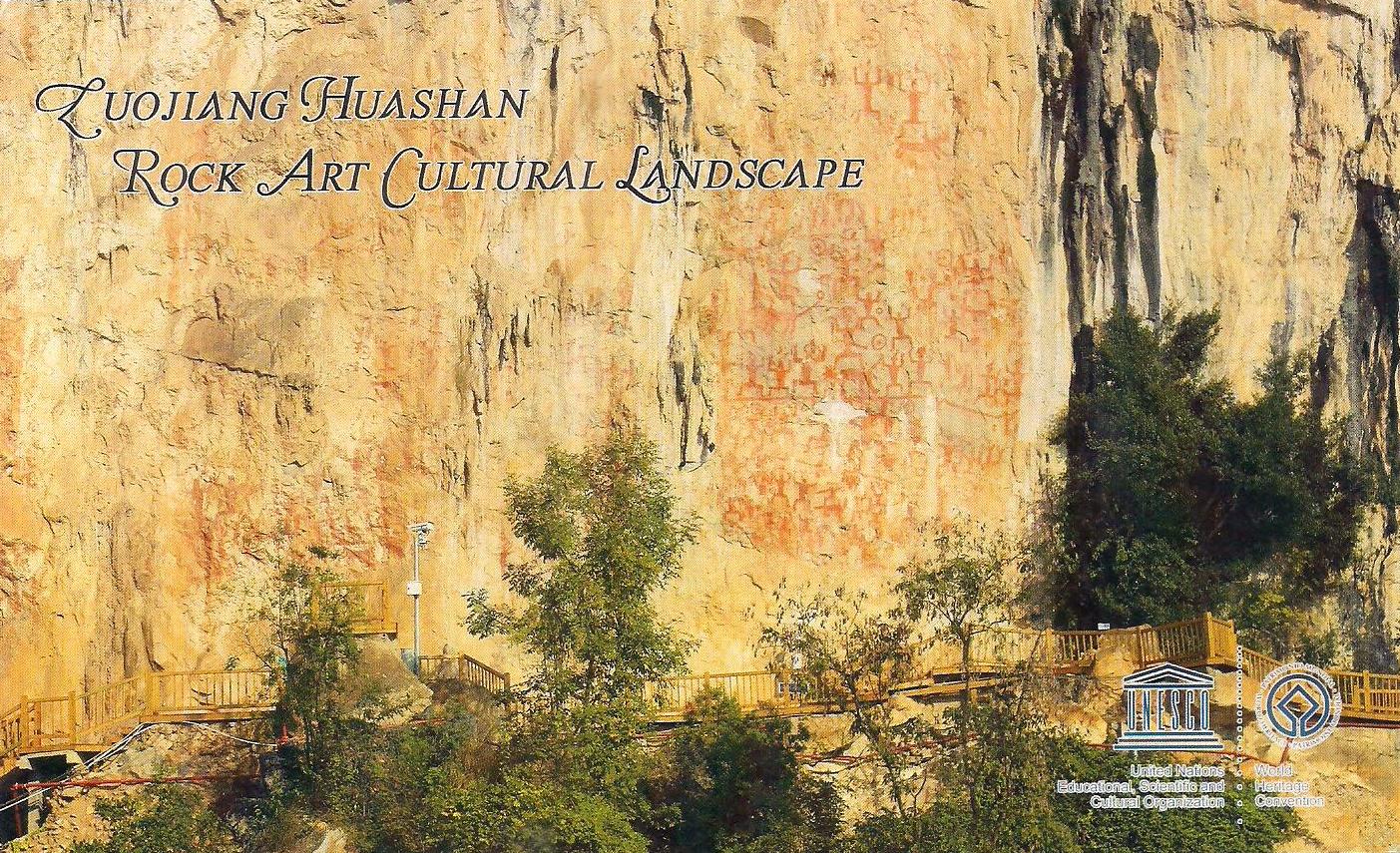
    CHINA - Zuojiang Huashan Rock Art Cultural Landscape

    "Located on the steep cliffs in the border regions of southwest China, these 38 sites of rock art illustrate the life and rituals of the Luoyue people. They date from the period around the 5th century BCE to the 2nd century CE. In a surrounding landscape of karst, rivers and plateaux, they depict ceremonies that have been interpreted as portraying the bronze drum culture once prevalent across southern China. This cultural landscape is the only remains of this culture today." -http://whc.unesco.org

    This is such an amazing UNESCO Site!
    I wonder how the Luoyue people were able to do this!
    Thank you so much Danise for completing my UNESCO WHS postcards from China!

    CHINA - Hubei Shennongjia

    "Located in Hubei Province, in central-eastern China, the site consists of two components: Shennongding/Badong to the west and Laojunshan to the east. It protects the largest primary forests remaining in Central China and provides habitat for many rare animal species, such as the Chinese Giant Salamander, the Golden or Sichuan Snub-nosed Monkey, the Clouded Leopard, Common Leopard and the Asian Black Bear. Hubei Shennongjia is one of three centres of biodiversity in China. The site features prominently in the history of botanical research and was the object of international plant collecting expeditions in the 19th and 20th centuries." -http://whc.unesco.org

    Thank you so much Danise for this great postcard with great stamps!

    Saturday, October 8, 2016

    CHINA - Historic Monuments of Dengfeng in “The Centre of Heaven and Earth”

    "Mount Songshang is considered to be the central sacred mountain of China. At the foot of this 1500 metre high mountain, close to the city of Dengfeng in Henan province and spread over a 40 square-kilometre circle, stand eight clusters of buildings and sites, including three Han Que gates - remains of the oldest religious edifices in China -, temples, the Zhougong Sundial Platform and the Dengfeng Observatory. Constructed over the course of nine dynasties, these buildings are reflections of different ways of perceiving the centre of heaven and earth and the power of the mountain as a centre for religious devotion. The historical monuments of Dengfeng include some of the best examples of ancient Chinese buildings devoted to ritual, science, technology and education." -http://whc.unesco.org

    Postcard 1: Shaolin Temple
    Another great postcard!
    Thank you so much, Chenzhan!

    CHINA - Capital Cities and Tombs of the Ancient Koguryo Kingdom

    "The site includes archaeological remains of three cities and 40 tombs: Wunu Mountain City, Guonei City and Wandu Mountain City, 14 tombs are imperial, 26 of nobles. All belong to the Koguryo culture, named after the dynasty that ruled over parts of northern China and the northern half of the Korean Peninsula from 277 BC to AD 668. Wunu Mountain City is only partly excavated. Guonei City, within the modern city of Ji’an, played the role of a ‘supporting capital’ after the main Koguryo capital moved to Pyongyang. Wandu Mountain City, one of the capitals of the Koguryo Kingdom, contains many vestiges including a large palace and 37 tombs. Some of the tombs show great ingenuity in their elaborate ceilings, designed to roof wide spaces without columns and carry the heavy load of a stone or earth tumulus (mound), which was placed above them." -http://whc.unesco.org

    Postcard 1: The General's Tomb
    Thank you so much for sending this wonderful postcard, Chenzhan!

    Wednesday, September 7, 2016

    CHINA - Chengjiang Fossil Site

    "A hilly 512 ha site in Yunnan province, Chengjiang’s fossils present the most complete record of an early Cambrian marine community with exceptionally preserved biota, displaying the anatomy of hard and soft tissues in a very wide variety of organisms, invertebrate and vertebrate. They record the early establishment of a complex marine ecosystem. The site documents at least sixteen phyla and a variety of enigmatic groups as well as about 196 species, presenting exceptional testimony to the rapid diversification of life on Earth 530 million years ago, when almost all of today’s major animal groups emerged. It opens a palaeobiological window of great significance to scholarship." -http://whc.unesco.org
    Postcard 1
    Thank you so much Luo Fei for increasing my UNESCO China collection!
    I am so close on completing the 50 UNESCO Sites from your country!
    I wish you happiness always as we are enjoying our hobby! ^-^


    Postcard 2


    Thank you so much for this nice card with nice stamp as well, Chenzhan!

    CHINA - The Grand Canal

    "The Grand Canal is a vast waterway system in the north-eastern and central-eastern plains of China, running from Beijing in the north to Zhejiang province in the south. Constructed in sections from the 5th century BC onwards, it was conceived as a unified means of communication for the Empire for the first time in the 7th century AD (Sui dynasty). This led to a series of gigantic construction sites, creating the world’s largest and most extensive civil engineering project prior to the Industrial Revolution. It formed the backbone of the Empire’s inland communication system, transporting grain and strategic raw materials, and supplying rice to feed the population. By the 13th century it consisted of more than 2,000 km of artificial waterways, linking five of China’s main river basins. It has played an important role in ensuring the country’s economic prosperity and stability and is still in use today as a major means of communication." -http://whc.unesco.org

    "This postcard shows Pingjiang Road session of the Grand Canal.
    It is located in Suzhou, once the riches city in China.
    I went to Suzhou in April. It is really beautiful, with lots of waterways..", shares Phoebe.
    Thank you so much Phoebe for this awesome postcard!

    Tuesday, September 6, 2016

    CHINA - Site of Xanadu

    "North of the Great Wall, the Site of Xanadu encompasses the remains of Kublai Khan’s legendary capital city, designed by the Mongol ruler’s Chinese advisor Liu Bingzhdong in 1256. Over a surface area of 25,000 ha, the site was a unique attempt to assimilate the nomadic Mongolian and Han Chinese cultures. From this base, Kublai Khan established the Yuan dynasty that ruled China over a century, extending its boundaries across Asia. The religious debate that took place here resulted in the dissemination of Tibetan Buddhism over north-east Asia, a cultural and religious tradition still practised in many areas today. The site was planned according to traditional Chinese feng shui in relation to the nearby mountains and river. It features the remains of the city, including temples, palaces, tombs, nomadic encampments and the Tiefan’gang Canal, along with other waterworks." -http://whc.unesco.org

    Another great postcard with equally great stamps!
    Thank you so much Danise for making my day!

    CHINA - Mount Wutai

    "With its five flat peaks, Mount Wutai is a sacred Buddhist mountain. The cultural landscape is home to forty-one monasteries and includes the East Main Hall of Foguang Temple, the highest surviving timber building of the Tang dynasty, with life-size clay sculptures. It also features the Ming dynasty Shuxiang Temple with a huge complex of 500 statues representing Buddhist stories woven into three-dimensional pictures of mountains and water. Overall, the buildings on the site catalogue the way in which Buddhist architecture developed and influenced palace building in China for over a millennium. Mount Wutai, literally, 'the five terrace mountain', is the highest in Northern China and is remarkable for its morphology of precipitous slopes with five open treeless peaks. Temples have been built on this site from the 1st century AD to the early 20th century." -http://whc.unesco.org

    "UNESCO Mount Wutai is a Buddhist Sacred Site. 
    As host to over 53 sacred monasteries, it's home to many of China's
    most important monasteries and temples...", shared Danise.
    Great great panoramic postcard!
    Thank you so much Danise for sending this over and be part of my collection!

    Monday, May 16, 2016

    CHINA / KAZAKHSTAN - Silk Roads: the Routes Network of Chang'an-Tianshan Corridor

    "This property is a 5,000 km section of the extensive Silk Roads network, stretching from Chang’an/Luoyang, the central capital of China in the Han and Tang dynasties, to the Zhetysu region of Central Asia. It took shape between the 2nd century BC and 1st century AD and remained in use until the 16th century, linking multiple civilizations and facilitating far-reaching exchanges of activities in trade, religious beliefs, scientific knowledge, technological innovation, cultural practices and the arts. The thirty-three components included in the routes network include capital cities and palace complexes of various empires and Khan kingdoms, trading settlements, Buddhist cave temples, ancient paths, posthouses, passes, beacon towers, sections of The Great Wall, fortifications, tombs and religious buildings." -whc.unesco.org
      
    Postcard 1: Kizil Cave Temple (Jimshar,  Xinjiang)
    Great view of the Kizil Grottoes in Baicheng County.
    Thank you so much, Danise for increasing my UNESCO postcards collection from China!

    CHINA - Imperial Tombs of the Ming and Qing Dynasties

    "It represents the addition of three Imperial Tombs of the Qing Dynasty in Liaoning to the Ming tombs inscribed in 2000 and 2003. The Three Imperial Tombs of the Qing Dynasty in Liaoning Province include the Yongling Tomb, the Fuling Tomb, and the Zhaoling Tomb, all built in the 17th century. Constructed for the founding emperors of the Qing Dynasty and their ancestors, the tombs follow the precepts of traditional Chinese geomancy and fengshui theory. They feature rich decoration of stone statues and carvings and tiles with dragon motifs, illustrating the development of the funerary architecture of the Qing Dynasty. The three tomb complexes, and their numerous edifices, combine traditions inherited from previous dynasties and new features of Manchu civilization." -http://whc.unesco.org

    Postcard 1
    Thank you Karas for this card for our RR!

    Postcard 2: Xianling Tomb, Zhongxiang, Hubei Province


    Thank you so much Sukie for sharing with me this great postcard!
    Special thanks for the matching stamp you used and other nice stamps as well!
    I truly appreciate this card...

    Postcard 3: Stone Arch at the Qing East Tomb, Zunhia, Hebei Province


    Thank you so much, Danise for sharing with me this great postcard!